
Reviewed · BOGOTÁ TOURS
Graffiti Tour: a fascinating walk through a street art City
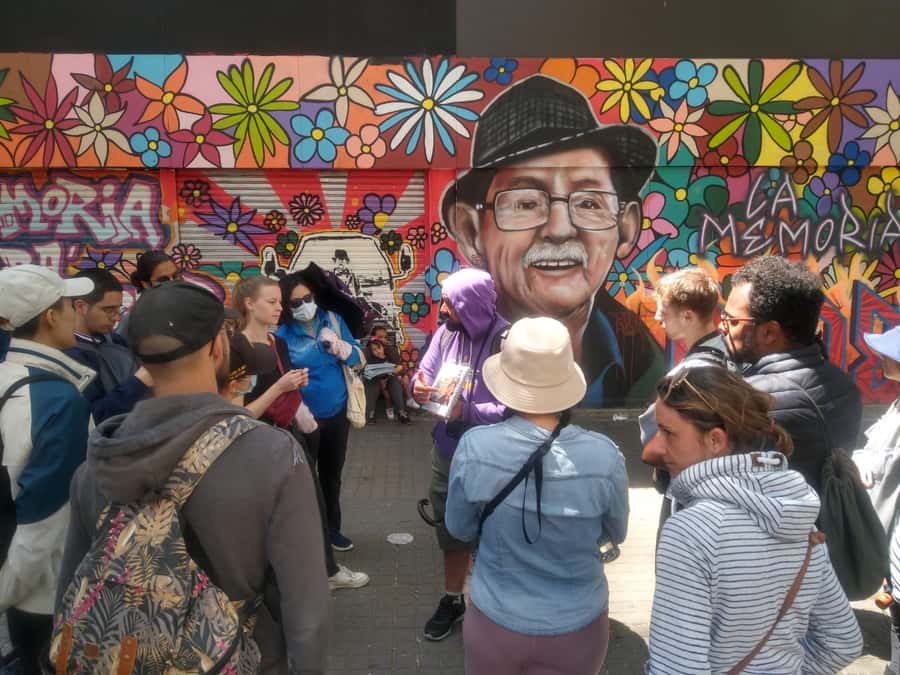
Bogotá’s graffiti is not just colorful wall decoration. It is a public record of protest, memory, conflict, and hope, and this 150-minute walk puts those ideas in front of you at street level. You’ll see the country’s tallest illegal graffiti work and political posters that address current social issues.
I like the clear social purpose behind the tour, since part of the money helps local artists and community leaders fund and manage new murals. I also like that the guides are artists themselves, so the walk covers technique as well as politics, geography, and history. The main drawback is that the experience asks you to concentrate for two and a half hours, and some subjects, including false positives and Colombia’s difficult past, may feel heavy.
Key points to know before you book
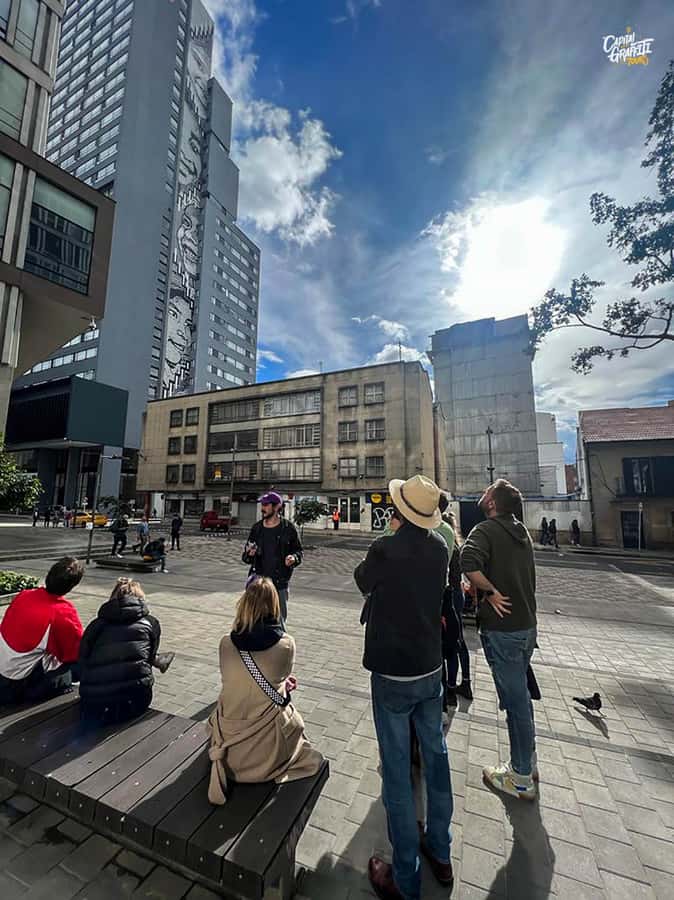
- The tallest illegal graffiti in Colombia: One of the tour’s headline sights gives you a sense of the scale and risk involved in Bogotá’s street art.
- Political posters with a purpose: The route includes public art linked to current social issues and Colombia’s peace process.
- A social-impact model: Your payment supports the work of artists and community leaders, not just a standard sightseeing operation.
- A meeting point beside the Gold Museum: Look for a guide wearing a purple hoodie or cap, or carrying a purple umbrella, at Carrera 6 # 15-88.
- A flexible group format: You can book a shared walk, a private tour, or a small-group outing.
- Five guide languages: Tours are offered in English, Spanish, Italian, French, and German.
Bogotá’s walls tell a political story
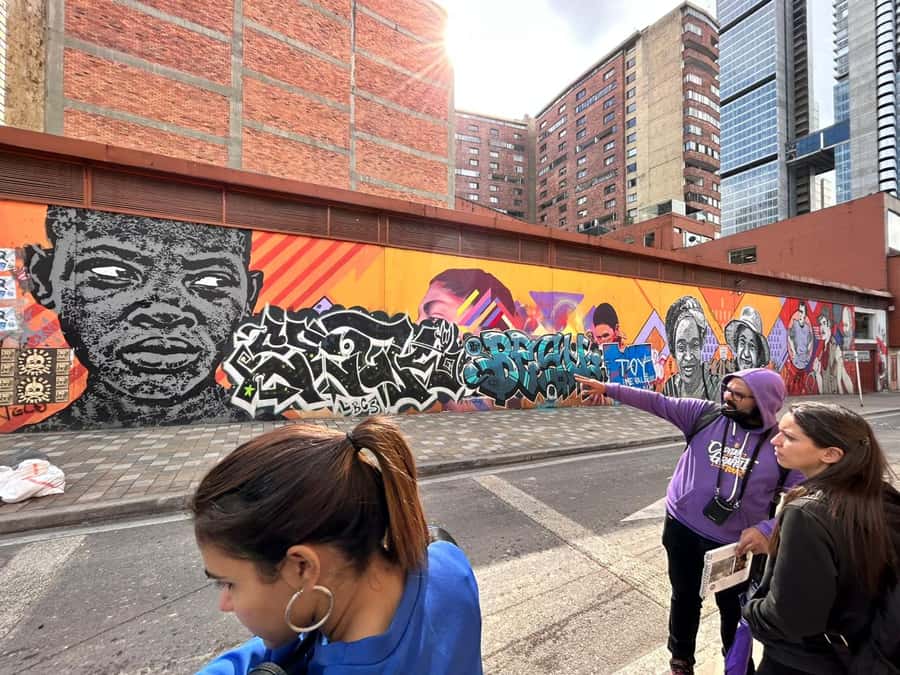
The best reason to take this walk is simple: it helps you read the city. Bogotá’s public art often deals with subjects that are hard to discuss in a museum or classroom. Murals and posters can address political power, social inequality, the peace process, and the persistence of communities affected by violence.
You are not only being shown where the art is. You are given the context needed to understand why it was created, who it speaks to, and how it relates to Bogotá today. That matters because a large painted wall can look striking even when you know nothing about it. With the right explanation, it becomes a statement about the people and events around it.
The tour also presents Colombia as a country looking forward without pretending that the past has disappeared. The focus on resilience in the face of false positives gives the walk a serious human dimension. This subject is part of Colombia’s painful conflict story, and the tour uses public art to show how communities remember and respond.
You should expect a cultural walk rather than a simple photo stop. The goal is to connect the images with the city’s social life. If you prefer tours that stay light and purely visual, this may feel more serious than expected. If you want to understand why Bogotá’s graffiti has such force, that seriousness is a major benefit.
More Walking Tours in Bogota
- Bogotá: Guided La Candelaria Walking Tour
★ 4.8 · 1,229 reviews - Zipaquirá Salt Cathedral Private Tour + Walking Tour
★ 5.0 · 66 reviews - La Candelaria Walking Private Tour (3 Hrs.)
★ 5.0 · 51 reviews
Starting beside the Gold Museum
The meeting point is next to the Gold Museum at Carrera 6 # 15-88. This is a practical place to begin because it is a clear city landmark, but the purple identifier is the detail you should remember. Look for your guide in a purple hoodie, purple cap, or with a purple umbrella.
The meeting instructions are especially useful in a crowded central area. Give yourself enough time to reach the Gold Museum and locate the guide before the start. You do not need to bring valuables, since they are not allowed on the activity.
The walk begins in the city center and then moves through several street art locations. The exact order of the stops is not specified, so you should think of the experience as a guided route through a series of works rather than a fixed museum-style sequence. Wear shoes suited to walking and keep your attention on the guide as the group moves between pieces.
Reading the tallest illegal graffiti in Colombia
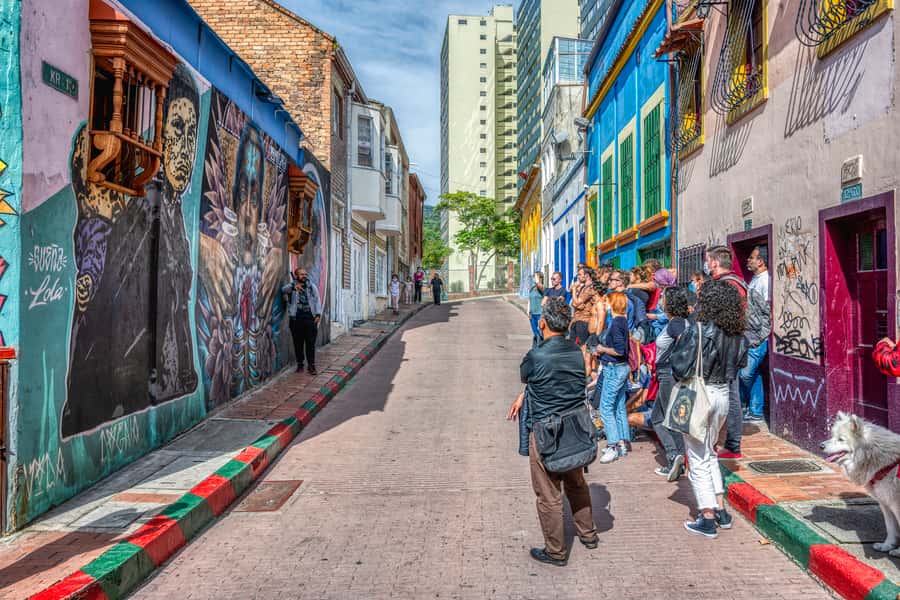
One major highlight is the chance to see the tallest illegal graffiti in the country. The scale alone helps explain why Bogotá’s street art has become internationally important. A work of that size is not just a painting placed on a wall. It changes how you see the building, the street, and the amount of planning required to create it.
The word illegal is important here. It points to the tension that has long shaped graffiti: the desire to claim public space without waiting for official permission. Your guide can place the work within that larger question of who gets to speak in a city and who controls its walls.
This stop should also help you notice technique. The tour is led by artists, and they discuss the methods and sources of inspiration behind the work. You may find yourself looking at scale, placement, color, lettering, and the way an image interacts with the building around it.
A practical point: the tallest work is a headline sight, but it is not the whole tour. Do not judge the experience only by the largest mural. The smaller political posters and more focused community pieces may give you a clearer sense of the city’s current concerns.
Political posters and present-day debate
The tour includes an area filled with political posters addressing current social issues. Posters work differently from large murals. They can be direct, temporary, and easy to repeat. Their power often comes from their wording and timing, while a mural may rely more on scale and visual symbolism.
This section gives you a chance to see street art as public conversation. The material is not presented as decoration separated from daily life. It reflects arguments and concerns that people want seen in the places where they work, walk, and gather.
Your guide provides political, cultural, historical, and geographical context. That range is useful because a poster rarely explains its full meaning to someone seeing it for the first time. You may understand the image quickly, yet miss its connection to Colombia’s peace process or to a specific social issue without guidance.
I appreciate that the tour does not treat politics as an optional extra. In Bogotá, political expression is central to the identity of much of the graffiti. Still, you should come ready to listen and ask questions rather than expect a quick parade of colorful backdrops.
More street art walks in Bogota:
- Bogotá: La Candelaria Graffiti & Urban Art Guided Tour
★ 4.7 · 250 reviews - Fun Graffiti Workshop: The Art of Aerosol and Color
★ 5.0 · 73 reviews - Graffiti Tour in La Candelaria Bogotá with Transportation
★ 5.0 · 68 reviews - Bogotá: Graffiti Tour el mejor recorrido de arte urbano
★ 4.7 · 41 reviews
Art, memory, and the false positives
The reference to false positives is one of the most serious parts of the experience. The tour connects public art with the resilience of communities that have faced the consequences of this painful period in Colombia’s conflict. The subject is not reduced to a label. It is presented through the way communities use art to remember, speak, and keep going.
This is where the social purpose of the tour becomes especially clear. Murals can create a shared place for memory. They can also challenge official silence and give local people a way to shape the story told about their neighborhood.
You should not expect a detached art lecture. The walk links images to real social questions and to Colombia’s attempt to build peace. Some visitors will find this the most meaningful part of the experience, while others may want more time to process the subject than a walking tour allows.
If you are sensitive to discussions of political violence, keep that in mind before booking. The serious material is not a flaw, but it does shape the mood. This is a better choice for someone interested in how art affects society than for someone seeking only an easygoing afternoon outdoors.
Meeting the artists behind the walls
The guides are artists and promoters, rather than only sightseeing hosts. That distinction affects the tone of the walk. You hear about artists, techniques, and sources of inspiration from people connected to the creative side of the subject.
The tour aims to explain how the work is made as well as what it means. You may learn to pay attention to the difference between a quick tag, a political poster, a large mural, and a carefully planned public artwork. The experience also shows how artists respond to the shape of a wall and the movement of people through a street.
No individual guide names are provided, so you cannot request a specific guide in advance from the available information. You can choose among English, Spanish, Italian, French, and German, which makes the activity useful for mixed-language groups.
The guide’s role is important because street art can be easy to miss. A wall may look like a single image from a distance, yet contain several artists, layers, or references. Good interpretation turns the route into a conversation about creative choices and city life.
Why the social-impact model matters
Capital Graffiti Tours presents itself as an arts and cultural organization with a social goal. The company works with local artists and community leaders, and it reinvests in the financing and management of new murals.
That gives the $15 price more meaning than a basic admission fee. You are paying for 150 minutes with a guide, but the stated purpose also includes supporting future public art and cultural work. For a visitor who wants money to reach local creative projects, this is a strong point.
The shared option uses a special payment model. Your per-person price is treated as the suggested amount for the guides’ work and tip, minus commission, and you do not need to pay anything extra at the end, even if other people in the group choose to tip. That makes the final cost easier to understand.
The value depends on what you want from a city walk. If you only want to take photos, $15 may feel less compelling than a free self-guided route. If you want interpretation, language support, and a direct connection to local art projects, the price is reasonable.
Two and a half hours at street level
The 150-minute duration is long enough to move beyond a quick introduction. You have time to see multiple street art locations and place different styles beside one another. The length also gives the guide room to explain political and cultural context instead of rushing from wall to wall.
At the same time, two and a half hours requires steady attention. You will likely spend the outing walking, stopping, listening, and looking closely. Since the exact route and stop list are not specified, you should check the available start times and be prepared for an active city-center experience.
The walk is wheelchair accessible, which makes it more suitable for a wider range of visitors. If you need to confirm the practical details of the route for your specific mobility needs, contact the provider before booking, since the available information does not describe every surface or street crossing.
Shared tours let you meet other people, while private and small-group formats offer a more focused setting. A private option may suit you if you want to ask many questions about technique or politics. A shared walk is likely the better value if you enjoy a social group and want to keep the cost at $15 per person.
How to get more from the walk
Arrive at the Gold Museum meeting point with the purple clothing or umbrella detail in mind. Keep valuables at your accommodation or in a secure place, since they are not allowed on the tour.
I would also suggest approaching the walk with two kinds of attention. First, look at the visible image: composition, scale, lettering, and color. Then listen for the less visible story: the political issue, local memory, artist’s purpose, or community connection.
Do not expect every work to offer a simple message. Political art can be dense, and the meaning may depend on events or debates you do not already know. Ask questions when something is unclear. The artist-guides are there to provide the context that makes the images easier to read.
You may also want to take notes on artists and techniques if you plan to explore more of Bogotá’s street art later. The tour is designed to expand your understanding of the city’s creative culture, not just to show you a handful of walls.
Who should book this Bogotá graffiti tour?
This walk suits you if you want to connect art with Colombia’s politics, peace process, and community life. It is also a good match if you value local guides, social projects, and cultural programs that continue after your visit.
It is less suitable if you want a short, purely visual activity with no difficult subjects. The discussion of false positives and current social issues gives the outing weight. You should also consider the 150-minute duration if your schedule is tight.
Families, couples, solo visitors, and groups can all use the format, provided they are comfortable with the walking time and subject matter. The choice of five languages is helpful for international groups, and wheelchair accessibility removes one common barrier to joining.
Should you book it?
Book this tour if Bogotá’s graffiti interests you as a form of public speech, not merely as colorful scenery. The tallest illegal graffiti, political posters, and stories of community resilience give the walk a clear purpose, while the artist-guides add practical insight into how the work is made.
At $15, the shared option offers good value for a guided cultural experience with a stated benefit for local artists and community leaders. Choose a private or small-group format if you want more room for questions. Skip it only if you prefer light sightseeing or cannot give two and a half hours to a serious, discussion-based walk.
FAQ
Where does the graffiti tour meet?
The meeting point is next to the Gold Museum at Carrera 6 # 15-88 in Bogotá.
How do I identify the guide?
Look for a guide wearing a purple hoodie or cap, or carrying a purple umbrella.
How long does the tour last?
The tour lasts 150 minutes, or two and a half hours.
How much does the tour cost?
The listed price is $15 per person.
What languages are available?
The tour is available in English, Spanish, Italian, French, and German.
Is the tour wheelchair accessible?
Yes, the activity is wheelchair accessible.
Can I book a private tour?
Yes. Private and small-group options are available, as well as the shared option.
What does the tour cover?
You will visit multiple street art and graffiti locations, see the country’s tallest illegal graffiti, explore political posters connected with current social issues, and hear context about Colombia’s past, peace process, and future.
More Street Art in Bogota
- Bogotá Street Art and Graffiti Tour 3 Hrs
★ 5.0 · 5 reviews - Medellín: Private Comuna 13 Street Art Tour
★ 4.8 · 88 reviews - 2-Hours Street Art Walking Tour in Medellin Comuna 13
★ 5.0 · 54 reviews - History and Street Art Tour in Comuna 13
★ 5.0 · 35 reviews
Just added around Bogota
- Fun Graffiti Workshop: The Art of Aerosol and Color★ 5.0 · 3 reviews
- Zipaquirá: Private Salt Cathedral Mine and Walking Tour★ 4.8 · 3 reviews
- Walking tour José Celestino Mutis Botanical Garden 3 hrs★ 5.0 · 3 reviews
- Bogota: East Hills Mountain Hike★ 4.2 · 3 reviews
- Bogota: Explore the forest and bird watching at Chicaque Natural Park★ 5.0 · 3 reviews
- Bogota: Downtown City and Monserrate Hill Private Tour★ 3.7 · 3 reviews
- From Bogota: White Water Rafting Experience★ 4.4 · 3 reviews
- From Bogota: Excursion to Jaime Duque Park★ 5.0 · 3 reviews
Bogotá Tours, compared.
Zipaquirá: Salt Cathedral Group Tour with Pickup
Read our review →
Bogotá´s Barrios: El Paraíso Favela Tour with Cable Car
Read our review →
Bogota: Guatavita and Salt Cathedral Daily Group Tour
Read our review →
Bogotá City Tour with Monserrate, Gold and Botero Museums
Read our review →
Bogota: Zipaquirá Salt Cathedral and Lake Guatavita Day Tour
Read our review →
Browse the lists this tour appears in