Reviewed · CARTAGENA TOURS
Shared Getsemani Art District Tour with Wireless Live System
Getsemani’s best stories are written on its walls and carried through its squares. This $9 shared walking tour links graffiti, Afro-Colombian resistance, music, and independence-era history, giving you a useful first look at the neighborhood beyond its bright paint and nightlife.
I like the wireless audio system, which lets you hear the guide while taking photos or standing a few steps away. I also like the stop with a local corozo drink and the chance to speak with elderly residents. The main drawback is the pace: you walk about 8 km in Cartagena’s heat, and this tour is not suited to wheelchair users or people with mobility impairments.
Key points at a glance
- Wireless audio makes a busy street tour easier to follow, especially near traffic, crowds, and lively squares.
- Getsemani’s resistance is the main subject, from Afro-Colombian uprisings to graffiti used as a modern form of protest.
- The route includes Centenario Park, Trinidad Square, The Well Square, and a San Felipe Fortress viewpoint.
- A shared group keeps the price low at $9, but you will not have a private guide or a custom route.
- You walk about 8 km over 2.5 hours, with resting stops, so bring water and wear proper shoes.
- The tour is offered in English or Spanish and ends back at the meeting point.
Why Getsemani deserves more than a quick evening stroll
Many people first meet Getsemani after dark, when music spills into the streets and Trinidad Square fills with people. That is part of its appeal, but it can hide the neighborhood’s harder story.
The tour presents Getsemani as a place shaped by people who resisted segregation and colonial control. You learn how an Afro-descended community helped drive Cartagena’s independence movement, then trace how that fighting spirit continued through painting, sculpture, dance, cinema, and music.
That context matters. Without it, the murals can look like cheerful decoration and the narrow streets can seem designed only for photos. With it, the colors, slogans, and public art become part of a long argument about identity and pride.
I find this a good choice early in a Cartagena visit. It gives you names and stories to attach to places you may later revisit on your own. It also helps you read Getsemani with more care instead of treating it as a backdrop for nightlife.
A few more Cartagena day trips to weigh up
- Cartagena: Historic Center and Getsemaní Shared Walking Tour
★ 4.9 · 2,716 reviews - Cartagena: Rosario Islands Catamaran with Lunch and Snorkel
★ 4.5 · 2,479 reviews - Full-Day Rosario Islands Including Barú, Bocachica & Playa Blanca
★ 4.0 · 1,729 reviews
Meeting the group under the red umbrellas
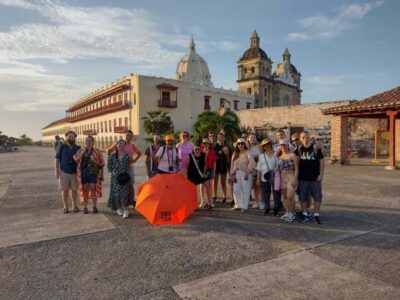
The meeting instructions give Plaza de la Proclamación, beside the Pope sculpture, as the weekday meeting point. Look for the red Beyond Colombia umbrellas and arrive about five minutes early so the wireless audio equipment can be handed out.
The directions also list Plaza Santo Domingo, beside Botero’s Gertrudis statue, for Saturdays and Sundays. Another section identifies Plaza de la Proclamación as the starting point, so check the meeting details attached to your booking, particularly for a weekend departure. The operator says the group may walk two blocks to the actual departure point after meeting.
This is a small detail, but it can save you a rushed start. Cartagena’s historic center has many similar-looking plazas, and arriving late may mean missing the equipment handout or the opening explanation.
The tour ends back at the meeting point. There is no hotel pickup, and no transport is used during the tour. You walk the whole route, with stops to rest and listen.
Wireless audio changes the feel of a group walk
The audio system is the practical feature that most directly affects the experience. Instead of crowding around the guide to catch every sentence, you can stand at a comfortable distance and still hear the explanation.
That gives you room to take pictures, examine a mural, or step out of the sun without losing the thread. It is especially useful on narrow streets, where traffic and passing groups can make a normal walking tour hard to follow.
The system does not turn this into a private experience. You are still part of a shared group, and the guide controls the route and timing. But it removes one common irritation of group tours: straining to hear while everyone bunches together.
You receive the equipment at the start and return it as the tour finishes. English and Spanish are available for both the live guide and the audio support.
Centenario Park and the road to independence
Centenario Park is one of the route’s key historical stops. The tour connects the park with Cartagena’s independence story, giving you a starting point for understanding why the city is known as La Heroica, the Heroic.
The point is not simply to memorize a date or admire a monument. The guide uses the setting to explain how Getsemani’s residents, many of them Afro-descended, took part in resistance and political change.
This is where the tour’s focus differs from a standard old-city walk. You are not only hearing about colonial buildings and military defenses. You are hearing about the people who lived on the edges of power and helped challenge it.
Centenario Park also gives the group a chance to pause before moving into the more concentrated streets of Getsemani. Expect a history lesson here rather than a long independent visit. The tour does not include an entrance to a paid attraction, and sudden extra charges are not part of the route.
Same city, a completely different kind of day:
- Cartagena de Indias: 2-Hour Sunset Cruise
★ 4.7 · 1,105 reviews - 2-hour tour in Cartagena Sunset View in party boat
★ 4.6 · 899 reviews - Cartagena: Guided Street Food Tour with Tastings
★ 4.9 · 833 reviews - Cartagena: City Sightseeing Hop-On Hop-Off Bus Tour & Extras
★ 3.9 · 681 reviews
Trinidad Square after the neighborhood wakes up
Trinidad Square is the social heart of the route. At night, it is associated with music, public gatherings, and Getsemani’s artistic movement. The square shows how a public space can function as a stage, meeting place, and statement of local identity.
Your guide explains the cultural activity around the square and how art helped shape the neighborhood’s modern image. This is useful because Getsemani can seem like a party district if you only see its restaurants, bars, and evening crowds.
The tour places that energy beside the neighborhood’s earlier struggles. The result is a fuller picture: celebration and resistance are not separate themes here. They are part of the same community story.
The practical issue is crowding. The square and nearby lanes can be busy, so keep your belongings close. The local advice is simple: do not make it easy for someone to take your phone or wallet. The audio system should help you follow the guide without standing in the middle of the crowd, but basic street awareness still matters.
The Well Square and Getsemani’s everyday character
The Well Square, also known as Plaza del Pozo, is included as another stop in the neighborhood. Here, the tour shifts from the major public square to a smaller space tied to local life and storytelling.
You can expect more explanation about how Getsemani developed as a community and how its streets became linked with folklore, music, and neighborhood pride. The value of a stop like this is its scale. Large squares explain public events, while smaller corners can show how ordinary residents use and remember their surroundings.
A walking tour cannot give you unlimited time at every location. You may want to return later to spend longer in the square, especially if you are interested in photography or evening street activity. Think of the visit as an introduction, not a full independent exploration.
Graffiti, narrow streets, and public memory
The street-art portion is one of the tour’s strongest reasons to book. Getsemani’s murals are not treated only as colorful decoration. The guide explains graffiti as a form of resistance and connects the art to traditions, political memory, and neighborhood identity.
The route also draws attention to the area’s wide and narrow streets. Their shape and use help tell the story of a community that developed under social divisions and later became known for creative expression.
You will have opportunities to take photographs, but the tour’s real value comes from the explanation beside the image. A mural can be striking on its own. Knowing how the neighborhood uses public art to speak about pride, struggle, and belonging gives it more weight.
The wireless system helps here. You can stop briefly for a picture without losing the guide’s remarks, although you should keep moving with the group when asked. This is still a timed walking tour, not a free-form photo walk.
The Afro uprising and the living spirit of resistance
The tour’s central historical thread is the Afro uprising and the way resistance continues into the present. This is the material that gives the route its purpose.
You learn about a segregated and insurgent community during the colonial period, then follow the story into modern cultural movements. The connection between political resistance and artistic expression is the key idea. Dance, music, painting, sculpture, cinema, and graffiti all become ways for the neighborhood to speak.
I appreciate this approach because it avoids reducing Getsemani to old walls and attractive street scenes. The community is presented as active, not frozen in the past.
The subject can be serious, and the tour asks for an open mind. You should expect interpretation and historical context rather than a string of light anecdotes. If you want only architecture or food stops, another Cartagena walk may suit you better.
Speaking with local residents and tasting corozo
One memorable feature is the chance to speak with elderly local residents. The information provided does not promise a long interview or a particular person at every departure, so treat this as a possible part of the route rather than a guaranteed scheduled performance.
When it happens, it adds a human voice to the tour’s historical material. A guide can explain the past, but a conversation with someone connected to the neighborhood can make the story feel less distant.
The tour also includes a courtesy shot of homemade natural corozo. This is a small taste, not a meal or a drinks tour. Food, additional drinks, and souvenirs are not included, so plan to buy anything else separately.
Corozo is a local fruit drink, and the sample gives you a quick connection to Colombian flavors without adding much cost. If you do not want the drink, you can simply ask what is being served before accepting it.
The San Felipe Fortress viewpoint and battle stories
The route finishes with a viewpoint toward San Felipe Fortress, where the guide discusses battles and victories. You do not pay an entrance fee to the fortress as part of this tour, and the route does not take you inside a ticketed attraction.
That distinction matters. The viewpoint gives you a useful visual link between Getsemani and Cartagena’s military defenses, but it is not a substitute for a dedicated fortress visit. If you want tunnels, ramparts, and a full look inside Castillo San Felipe de Barajas, plan that separately.
As a final stop, the viewpoint ties together the neighborhood’s political and military story. Getsemani’s residents fought for independence, while the fortress represents the battles that made Cartagena such an important Caribbean port.
The view also gives the group a natural moment to pause before returning to the start. Bring a camera, but keep expectations realistic. This is a viewpoint stop within a walking route, not a long scenic overlook session.
What the $9 price really gives you
At $9 per person, this is a low-cost way to get a guided introduction to Getsemani. The price covers an English or Spanish-speaking guide, the wireless audio system, the historical commentary, the main sightseeing stops, a corozo sample, and local recommendations.
The value is strongest if you want orientation and context. A good guide can help you understand where to eat, find coffee, buy souvenirs, and continue exploring after the tour. The wristband given at the end may also provide benefits or discounts with recommended local businesses.
You are not paying for transportation, food beyond the courtesy drink, entrance tickets, or private attention. You also do not get a guide dedicated only to your party. Since this is a shared tour, group size and pace can affect how personal the experience feels.
For the price, I would judge it as a strong introduction rather than a complete day of sightseeing. It covers a lot of ground and uses the neighborhood itself as the main attraction.
The walking demands and what to bring
The route lasts about 2.5 hours and covers roughly 8 km. That is a substantial walk, even with resting stops. Cartagena’s heat can make the distance feel longer, so bring water or another preferred drink.
Wear comfortable shoes, light clothing, a hat, and sunscreen. You do not need to dress formally. A camera is useful for the murals and street scenes, but keep your phone and other valuables secure in crowded areas.
The tour is not suitable for wheelchair users or people with mobility impairments. The long distance, narrow streets, and walking-only format are the reasons to take this seriously before booking.
Smoking, alcohol and drugs, and littering are not allowed. No special equipment is listed beyond the wireless audio system supplied at the start.
Who will get the most from this tour
I would choose this walk if you want Cartagena’s social and cultural story alongside its famous buildings. It suits people interested in Afro-Colombian history, public art, music, local traditions, and the forces that shaped modern Getsemani.
It also works well for solo visitors and couples who want a low-cost introduction without arranging a private guide. Because the tour is shared, you have a chance to meet other people, but you should not expect a custom route or long stops at every mural.
You may want something else if your priority is food tasting, nightlife, architecture interiors, or a slower photo session. The tour includes recommendations for local allies, but meals, drinks, and souvenirs are not part of the experience.
The free cancellation policy allows a full refund when you cancel at least 24 hours ahead, and reserve-now, pay-later booking keeps your plans flexible. Those terms are useful if your Cartagena schedule is still shifting.
My call: book it for context, not comfort
Book this tour if you want Getsemani explained through resistance, art, and local voices. The wireless audio system, low price, corozo sample, and stops at Trinidad Square and the San Felipe viewpoint give it more substance than a simple street-photo walk.
Skip it if an 8 km route sounds tiring or if you need step-free access. For everyone else, it is a practical first look at a neighborhood whose music, murals, and public squares make more sense once you know the struggle behind them.
FAQ
How long does the Getsemani tour last?
The tour lasts 2.5 hours.
How far do you walk?
You walk about 8 km, with resting stops along the way.
Is the tour offered in English?
Yes. The live guide and audio support are available in English and Spanish.
What does the wireless audio system do?
It lets you hear the guide from a short distance, so you can take photos and look around without crowding directly beside the guide.
Where does the tour meet?
The weekday meeting point is listed as Plaza de la Proclamación, beside the Pope sculpture. Weekend directions also list Plaza Santo Domingo beside Botero’s Gertrudis statue, so check the meeting information for your selected date.
What is included in the price?
The price includes the guide, wireless audio system, Getsemani sightseeing, a courtesy corozo shot, local recommendations, and a wristband with possible benefits at recommended businesses.
Are food, drinks, and entrance tickets included?
No. The courtesy corozo sample is included, but other food, drinks, souvenirs, and entrance tickets are not.
Is the tour suitable for wheelchair users?
No. The tour is not suitable for wheelchair users or people with mobility impairments.
Just added around Cartagena
- Cartagena: Ecoplan on Barú, Aviary and Oceanarium in one day★ 3.3 · 3 reviews
- CARTAGENA, EXCLUSIVE launch for Rosario and Baru Islands★ 5.0 · 3 reviews
- Cartagena: Day Tour to Tierra Bomba Island★ 3.2 · 3 reviews
- photo session through the streets of cartagena★ 5.0 · 3 reviews
- Cartagena Coffee Masterclass: Artisanal Roasting and Brewing★ 5.0 · 3 reviews
- FULL DAY BARRANQUILLA AND SANTA MARTA 1 DAY from Cartagena★ 4.0 · 3 reviews
- Cartagena: Cholon Island Boat PARTY with DJ and Lunch★ 3.7 · 3 reviews
- Cartagena: Basic Diving for beginners in Rosario Islands★ 3.4 · 3 reviews
Cartagena Tours, compared.
Cartagena: Historic Center and Getsemaní Shared Walking Tour
Read our review →
Cartagena: Rosario Islands Catamaran with Lunch and Snorkel
Read our review →
Full-Day Rosario Islands Including Barú, Bocachica & Playa Blanca
Read our review →
Cartagena: Guided Street Food Tour with Tastings
Read our review →
Cartagena: Panoramic City Tour, Monuments, Walls, Castle
Read our review →