
Reviewed · MEDELLÍN TOURS
Do Not Say That Name
Medellín’s troubled past is only half the story here. This private four-hour tour uses the former cartel era as a doorway into the city’s larger change, from violence and fear to public memorials, improved transport, street art, and community pride. You’ll see Parque Memorial Inflexión, the Jardines Montesacro cemetery, and San Antonio, with some tours also reaching Comuna 13.
I like the personal format, since private transportation and a bilingual guide let you ask direct questions instead of following a large group. I also like the chance to connect the old violence with Medellín’s public transformation, especially if Comuna 13 and its escalators or cable car are part of your route. The main caution is that the historical depth can depend heavily on your guide, and the advertised Escobar-related sites are more limited than television dramas may lead you to expect.
Key points to know before booking
- Parque Memorial Inflexión replaces the former Monaco building: You see a memorial park on the site, not the notorious building itself.
- Jardines Montesacro adds a sober historical stop: The cemetery visit is brief, with the grave area providing context rather than a long guided program.
- Comuna 13 may be a major part of the day: Several accounts describe escalators, murals, a local guide, and a metro cable ride, but the written stop list does not clearly promise every one of these.
- The private format is useful for questions: Transportation, a bilingual guide, and medical assistance are included for your group.
- Guide quality matters: Juan Carlos and Hector are praised for enthusiasm, while one account describes serious problems with English and historical detail from another guide.
- The $78 price buys convenience more than admission tickets: The listed stops are free, so the value rests in transport, interpretation, privacy, and the route.
Medellín’s past is the starting point, not the whole tour
It is easy to picture this as a four-hour hunt for famous crime scenes. That would set you up for disappointment. The former Monaco building is gone, the well-known ranch lies several hours outside Medellín, and the site connected with the cartel leader’s death has been rebuilt.
What you get instead is a look at places that help explain the period and its aftermath. The guide discusses the war against the cartel, the city’s hard years, and the changes that followed. At its best, the experience keeps the focus on Medellín rather than turning a violent past into a celebrity story.
That distinction matters. Popular television series can make the subject seem neat and cinematic. Medellín’s actual story is more complicated, and the tour’s stronger moments connect crime, politics, neighborhoods, transport, and public memory. You should arrive ready for history and interpretation, not a parade of preserved hideouts.
The tour is private, so your group alone takes part. That gives you a better chance to ask how a particular event affected the city, or to request more explanation when a stop feels too quick. It also means the guide’s strengths and weaknesses are more noticeable. A strong guide can make a simple memorial meaningful. A weak one can leave you standing beside a grave with little sense of why it matters.
A few more Medellin day trips to weigh up
- Medellin: Comuna 13 Graffiti Tour, Cable Car & Street Food
★ 4.8 · 9,046 reviews - Medellín: The Real Pablo Escobar Tour
★ 4.8 · 3,205 reviews - Medellín: Comuna 13 True Story and Street Food Tour
★ 4.9 · 1,779 reviews
Parque Memorial Inflexión: a memorial where a famous building once stood
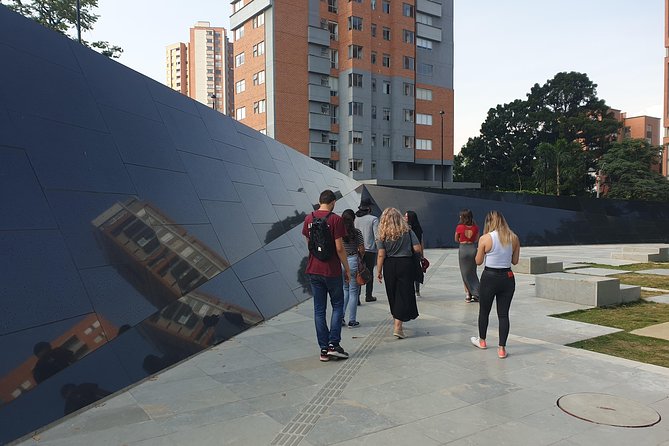
The first listed stop is Parque Memorial Inflexión, a public memorial built on the former site of the Monaco building. The building had become a symbol of pain and violence and was once owned by the cartel leader. It is no longer there, so do not expect to photograph the old structure.
The park’s importance is what replaced it. Rather than preserve a monument to criminal power, Medellín created a public place of remembrance on ground tied to fear and bloodshed. Your guide explains that setting and places the site within the city’s turbulent past.
You have about 15 minutes here, and admission is free. That is enough for an introduction and a short look around, but not a long seminar. If you want dates, names, and a clear timeline, ask for them directly. The experience works best when you treat this as a starting point for the story, not its complete explanation.
A shrine to the Virgin Mary is also part of the route information. It is described as a place where pilgrims ask for miracles. The details about its exact location and length of visit are not specified, so ask your guide how it fits into the day. It offers a different perspective on Medellín’s public life, one based on faith and hope rather than crime and notoriety.
Jardines Montesacro: a short, serious cemetery visit
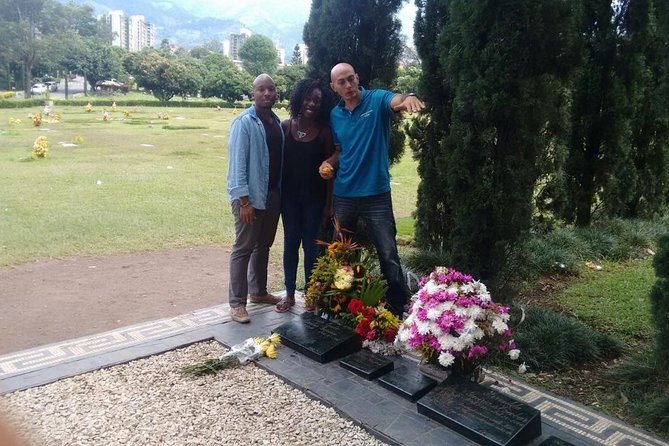
The tour then stops at Jardines Montesacro cemetery for roughly 20 minutes. The description calls this a short stop at the grave, so plan for a compact visit rather than a wide-ranging cemetery walk.
A grave can seem underwhelming if the guide gives only a name and a date. With proper context, it becomes a place to discuss the people and forces involved in Medellín’s violent period. One account also describes a visit to the grave of Griselda Blanco, known by the nickname Black Widow, and says her connection to the story was explained. Since the exact cemetery content may vary by guide, ask beforehand if this grave is included in your departure.
This is one of the places where the guide makes the difference. Juan Carlos is praised for making the story engaging, and Hector is described as enthusiastic and openly proud of Medellín. Another guide, Nicolas Zapata, received a sharply different assessment for offering scattered information and short answers. The contrast is a useful warning: a private tour is not automatically a well-taught tour.
You can help shape the stop. Ask who is buried there, why the person matters, and how the grave fits into the wider conflict. If your guide answers fully, the cemetery becomes a meaningful link between public history and individual lives. If the explanation stays thin, the visit may feel like a quick photo stop.
San Antonio and the shift in Medellín’s story
At Parque San Antonio, the guide explains the change in the war against the cartel. The stop lasts about 15 minutes and is also free.
The park is important because it helps move the tour from the era of violence toward the city’s later efforts to recover. The supplied description gives only a short explanation, so you should expect the guide to do most of the teaching here. Ask how the conflict changed daily life, what happened after the fighting eased, and how public spaces such as this one fit into Medellín’s recovery.
This is not necessarily a grand attraction with a long list of things to see. Its value is interpretive. You are using a central public place to understand a turning point in the city’s recent past. If you prefer a tour built around major monuments and long visits, this stop may feel brief. If you like connecting ordinary urban spaces to major events, it can be useful.
Same city, a completely different kind of day:
- Medellín: Comuna 13 District Tour with Cable Car Ride
★ 4.8 · 1,467 reviews - Medellin: Coffee Tour with Transport, Snacks and Tastings
★ 4.7 · 1,357 reviews - From Medellín: Paragliding Tour with GoPro Photos & Videos
★ 4.9 · 1,210 reviews - Tour Guatapé
★ 5.0 · 865 reviews
Comuna 13 may be the most rewarding part
Several accounts describe Comuna 13 as the most interesting portion of the experience. This is worth stressing because the formal route information names Parque Memorial Inflexión, the shrine, Jardines Montesacro, and San Antonio, but does not clearly list Comuna 13 as a stop. Yet the tour highlights and detailed accounts refer to it, along with escalators, murals, a local guide, and a cable car ride.
Confirm the route before you pay, especially if Comuna 13 is your main reason for booking. The difference matters. A visit there changes the experience from a short historical circuit into a broader look at Medellín’s social transformation.
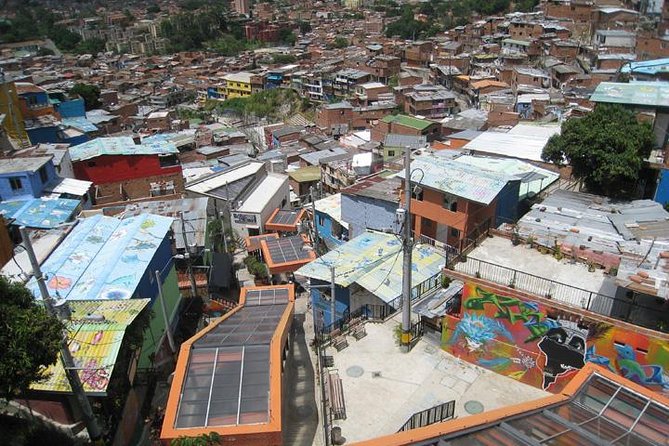
In Comuna 13, you may ride the public outdoor escalators and see murals, homes, shops, and steep streets. One account describes riding the escalators all the way upward, giving a close view into private homes and showing how the system changed movement through the neighborhood. The escalators are not just a sightseeing prop. They are part of the area’s public infrastructure and represent improved access in a place once known for violence and isolation.
A young local guide may join this part of the outing. That can be a real advantage because local knowledge gives the neighborhood a voice beyond the old cartel story. One highly praised guide is described as passionate about his community and its social changes. You may hear about the neighborhood before the transformation, the hardships residents faced, and the public projects that changed access.
Some accounts also describe a cable car ride, using the system that carries people through Medellín’s mountainous valley. The ride gives you a sense of how the city connects steep neighborhoods with the urban center. It is also a reminder that public transport can shape opportunity, not merely move people from one station to another.
Do not expect every Comuna 13 guide to offer the same level of detail. One account describes a local guide who focused on phone use, timing, sales stops, and brief explanations. If the guide moves too quickly, ask specific questions about the escalators, the community’s earlier conditions, and the events that led to change.
You may encounter stops connected with food, hats, art, shirts, or a hostel. Those purchases are personal expenses and are not included. They can support local businesses, but you should not feel that buying something is required to understand the neighborhood.
What the $78 price really covers
The cost is $78 per person. Since the listed attractions have no admission charge, you are mainly paying for private transportation, a bilingual guide, planning, and the ability to keep the day limited to your own group. Medical assistance is also listed as included.
For one person, the price may feel high compared with simply visiting public spaces independently. For a couple or small group, the calculation looks better because the private format spreads the transport and guide cost across your party. The value improves if you want a door-to-door outing, need English or another bilingual service, or prefer to ask questions without strangers listening.
The price is harder to justify if your guide offers little context or if the route skips the parts you expected. Food, drinks, and personal purchases are extra. Because the attractions themselves are free, the quality of narration is central to what you are buying.
Morning and afternoon departures are offered. Choose based on your wider Medellín plans and your appetite for walking or urban sightseeing at that time of day. The total duration is approximately four hours, although one account describes a five-hour experience, so keep a little flexibility around the schedule.
Guide quality deserves your attention
The strongest praise goes to guides who combine facts with pride in Medellín. Juan Carlos is described as making the experience magnificent, while Hector is praised for enthusiasm and for showing affection for his city from the start. Those qualities matter here because much of the tour is spoken explanation rather than ticketed sightseeing.
The weakest account describes a guide whose English was difficult to follow, whose chronology was unclear, and who gave short or incomplete answers. The group had to fill in missing information themselves. That is a serious problem on a history-based tour, particularly if you are booking for teenagers or family members who know the subject mainly from television.
Guide assignments can change, so you cannot assume you will receive a particular person. If you book, ask for a clear explanation of the route and whether the guide can discuss the history in the language you need. At each stop, ask questions. A private tour gives you that opening, and a good guide should welcome it.
The overall score is listed as 4.8 from 30 reviews, with 93 percent recommending the experience. That is strong, but the wide range of comments tells you what to watch: the tour can be excellent with an energetic historian and disappointing when the narration is thin.
Who will enjoy this experience most?
I would choose this for someone who wants a guided introduction to Medellín’s recent past but also wants to see how the city has changed. It suits first-time visitors who prefer private transport and families who want the freedom to ask questions. It can also work well for people interested in urban planning, public transport, memorials, and community projects.
It is less suitable if your sole goal is to visit preserved cartel locations. Many famous sites are gone, rebuilt, or far outside the city. It is also not ideal if you need a guaranteed, detailed account of every event associated with the subject. The guide’s depth varies, and the written route does not fully match every experience described.
Teenagers familiar with the television series may enjoy the subject, but I would explain beforehand that this is not a set visit from the show. It is a chance to compare popular storytelling with a broader account of Medellín’s past and present.
Practical details before you go
Confirmation is provided at booking. The tour is near public transportation, though private transportation is included, and most people can participate.
The listed stops have free admission. Bring money only if you want food, drinks, souvenirs, artwork, or other personal items. If you need to cancel, you can receive a full refund by doing so at least 24 hours before the local start time. Cancellations or changes inside that window are not accepted for a refund.
Because this is a private activity, your group is the only group participating. That is useful if you want to slow down at the cemetery, ask for more detail at San Antonio, or clarify what you are seeing in Comuna 13.
Should you book it?
Book this tour if you want the convenience of private transport and a bilingual guide, and if you are curious about Medellín’s recovery as much as its cartel era. The strongest version links the memorial park and cemetery to Comuna 13’s escalators, murals, local stories, and cable car. That gives you a much fuller picture than a simple crime-site checklist.
Before booking, confirm three things: the exact stops, whether Comuna 13 is included, and how much historical explanation you can expect in your preferred language. At $78 per person, the experience is worth it when the guide is prepared and the route includes the city’s social transformation. If you want only famous criminal landmarks, save your money. Many of those places no longer exist, and this tour is really about Medellín moving beyond them.
FAQ
How long is the tour?
The advertised duration is approximately four hours. One detailed account describes a five-hour outing, so allow some flexibility around the end time.
What locations are included?
The listed route includes Parque Memorial Inflexión, a shrine to the Virgin Mary, Jardines Montesacro cemetery, and Parque San Antonio. Detailed accounts also describe Comuna 13 and a cable car, but you should confirm those additions before booking.
Is the tour private?
Yes. Only your group participates in the activity.
Is transportation included?
Yes. Private transportation is included, along with a bilingual guide and medical assistance.
Are entrance tickets included?
The listed stops have free admission, so no paid admission is specified. Food, drinks, and personal expenses are not included.
Can I choose a departure time?
You can choose between a morning or afternoon tour.
What is the cancellation policy?
You can cancel at least 24 hours before the local start time for a full refund. Cancellations or changes made less than 24 hours before the start are not accepted for a refund.
Just added around Medellin
- Comuna 13: Recorrido de Arte Urbano, Cultura y Resiliencia★ 5.0 · 3 reviews
- Tour to Río Claro and La Caverna del Cóndor★ 5.0 · 3 reviews
- Medellin: Tour to The Cathedral – History of Pablo Escobar and his Impact★ 5.0 · 3 reviews
- Medellin: waterfalls and naturals poolls tour★ 3.7 · 3 reviews
- Medellín: Coffee Tour Experience at a Coffee Farm★ 4.8 · 3 reviews
- Medellín: Private City Tour and Comuna 13 Tour★ 3.8 · 3 reviews
- Tour Medellín: Pablo Escobar and Commune 13★ 5.0 · 3 reviews
- Colombia: Official Pablo Escobar Meet the Family Museum Tour★ 5.0 · 3 reviews
Medellín Tours, compared.

Medellin: Comuna 13 Graffiti Tour, Cable Car & Street Food
Read our review →
Medellín: Comuna 13 True Story and Street Food Tour
Read our review →
Medellín: Comuna 13 District Tour with Cable Car Ride
Read our review →
Medellin: Coffee Tour with Transport, Snacks and Tastings
Read our review →
From Medellín: Paragliding Tour with GoPro Photos & Videos
Read our review →
Medellín: Pablo Escobar Tour with beer included
Read our review →Browse the lists this tour appears in