
Reviewed · MEDELLÍN TOURS
Shared Medellín Downtown Tour with Wireless Audio
Medellín’s downtown tells the city’s whole story in a few city blocks: railroad wealth, Paisa enterprise, public art, social investment, and the hard years of the 1980s and 1990s. I like this tour because it does not reduce Medellín to drug-trafficking headlines, and because the wireless receivers let you listen while taking photos or crossing busy streets. Guides such as Miguel, Santiago, Carolina, and Deisy are praised for explaining both the past and the city’s present direction.
I also like the practical value. For $13, you get about three hours on foot, local recommendations for coffee, lunch, and souvenirs, and a useful introduction to downtown before exploring more of Medellín. The tradeoff is real: you walk about 8 kilometers, sometimes through crowded and gritty areas, so this is not a gentle stroll or a good fit for anyone with mobility limitations.
Key points to know before you book
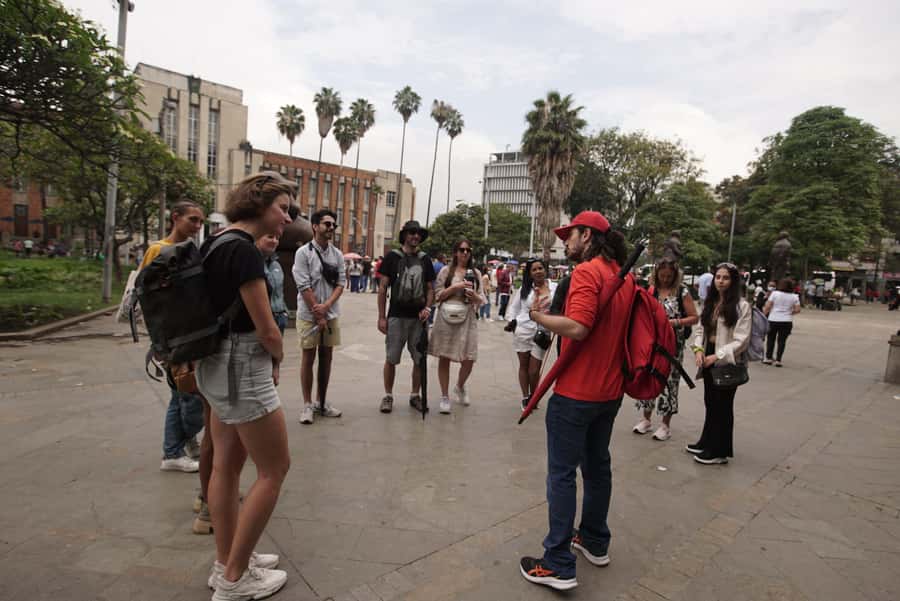
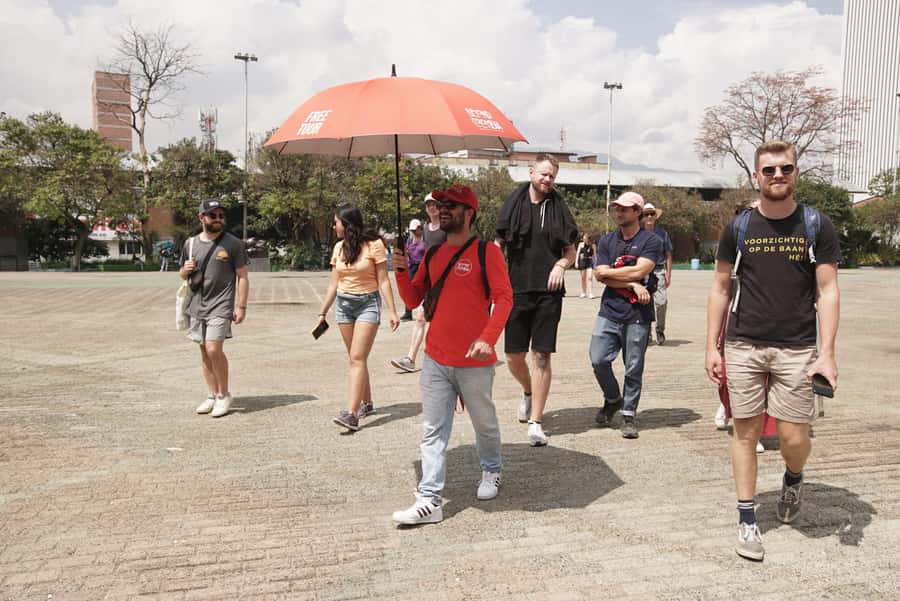
- Botero Plaza is the starting point: Meet the guide with a red umbrella in front of the Museo de Antioquia.
- The tour tackles difficult subjects: You’ll hear about the violence of the 1980s and 1990s without making that the city’s entire identity.
- The route links art and industry: Botero’s sculptures, Junín Street, the railroad, La Alpujarra, and the Park of Lights form a clear story about Medellín’s growth.
- Wireless audio makes a difference: You can hear the guide in noisy streets and keep your hands free for photos.
- Expect a long walk: Plan for roughly 150 minutes to three hours, around 8 kilometers, with pauses to listen and rest.
- The price is unusually low for the time: At $13, the tour offers strong value if you want orientation, context, and honest conversation rather than paid admissions.
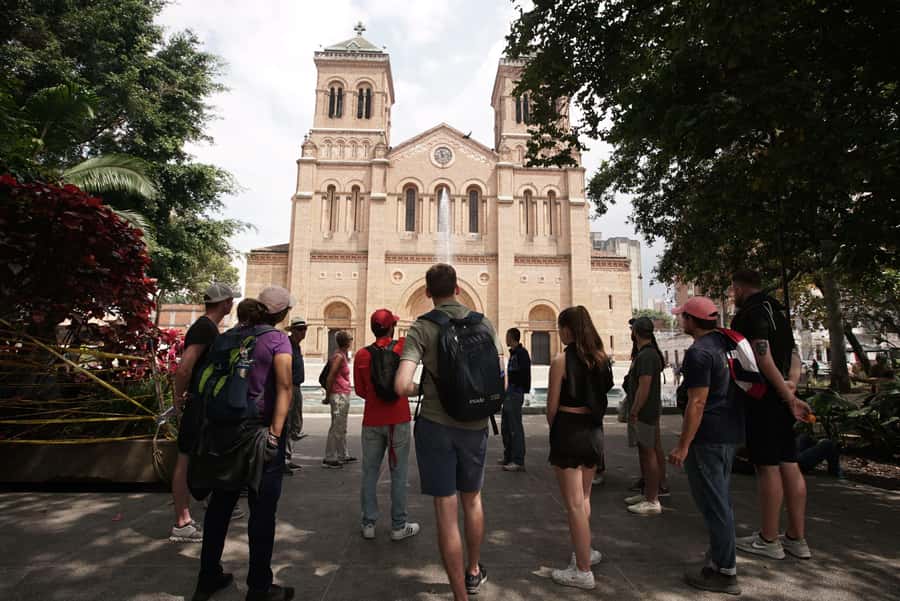
Starting at Botero Plaza beside the Museo de Antioquia
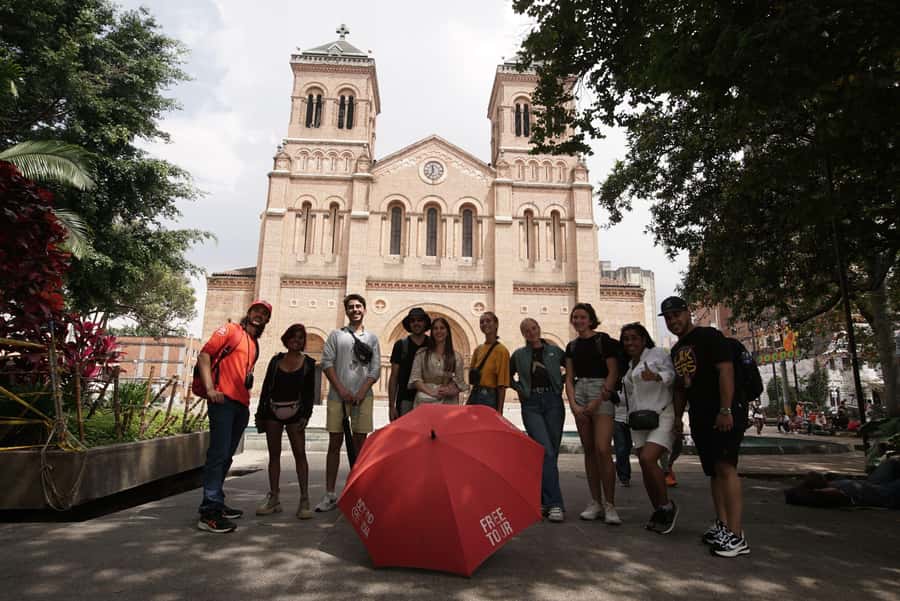
Your meeting point is easy to identify: the Beyond Colombia team gathers in front of the Museo de Antioquia at Botero Plaza, carrying red umbrellas. This puts you in the middle of downtown from the first minute, rather than wasting time on hotel pickups or a long ride to the route.
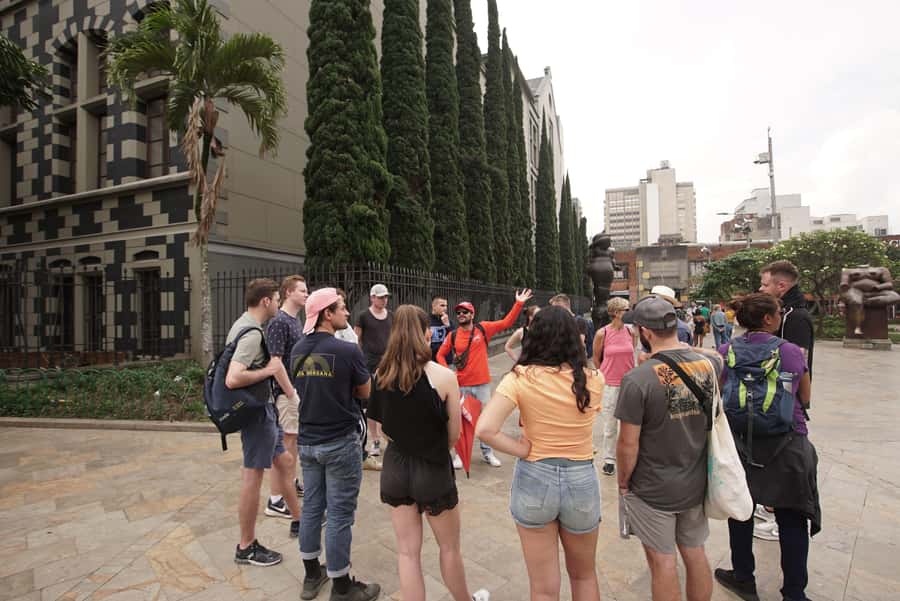
Botero Plaza is more than a convenient meeting point. Fernando Botero’s large bronze figures give the square an unmistakable identity, and the art provides a natural opening for a conversation about Colombian culture, public space, and Medellín’s relationship with one of its best-known artists.
You’ll likely spend time looking at the sculptures and learning about Botero’s work and contribution to the city. Several guides are singled out for explaining his life and art in a clear, entertaining way. Santiago, in particular, is noted for connecting Botero’s work with the wider story of Medellín rather than treating the square as a quick photo stop.
The area can be busy, and you should keep your phone, wallet, and bag close. The guide will help you find the group, but crowded downtown streets still require ordinary city awareness.
A few more Medellin day trips to weigh up
- Chiva Private Cultural Tour with Audio Guide in Buga
★ 5.0 · 49 reviews - Shared Cartagena Old City Tour with Wireless Audio System
★ 4.4 · 28 reviews
Reading Medellín through Botero’s public art
The art portion gives the tour a welcome change of pace. Instead of hearing one long lecture about dates and political events, you get visual reference points. Botero’s sculptures help you notice how Medellín uses art in public areas and how downtown presents itself to residents and visitors.
The guide’s job here is not just to name the artist. You can expect connections between Botero, Medellín, and Colombia, along with discussion of why his work matters in the city. This is useful if you know little about Colombian art, but it also gives art-minded visitors more to consider than a standard introduction.
The tour also includes murals and other public art along the route. These stops add a social side to the walk. You may find that the guide spends less time on formal art criticism and more time explaining what particular works mean in the city’s public life.
That approach suits the tour’s larger purpose. Medellín is presented as a place that has used culture, public investment, and shared spaces to help reshape its image and daily life. The account is positive about the city’s progress, but the better guides keep the problems in view too.
Junín Street and the everyday center of the city
From the plaza, the route moves through passages and along famous Junín Street. This is where the tour shifts from grand symbols to daily downtown life. You’ll see the kind of streets that make Medellín more understandable than any polished viewpoint or hotel district can.
The walk is not designed as a shopping tour, but Junín helps explain the commercial side of the city. The guide discusses Paisa industry and culture, two themes that are central to understanding Medellín’s importance in Colombia.
The term Paisa refers to the regional culture associated with Antioquia and nearby areas. On this walk, you’ll hear how enterprise, trade, family networks, and regional identity helped shape the city. The tour does not treat Paisa culture as a slogan. It uses streets, businesses, public buildings, and local stories to show why the culture matters.
This section also gives you a chance to ask practical questions. Guides including Miguel, Manuel, Alex, and Daniel are praised for answering questions about local life and current affairs rather than repeating a fixed script. That flexibility can make a shared tour feel more personal, especially when the group is small.
You should not expect every group to have the same guide or the same rhythm. Some guides may spend more time on politics, others on art, buildings, or personal stories. That variation is part of the shared-tour format.
Medellín’s railroad story at La Alpujarra
The railroad and La Alpujarra form one of the route’s most useful historical chapters. Medellín’s growth cannot be understood only through modern technology and urban renewal. Rail connections helped link the city to wider trade and made industrial development possible.
At La Alpujarra, the guide places that development in a physical setting. You’ll learn why the railroad became a symbol of progress and why the area matters to Medellín’s civic identity. This is one of the tour’s strongest sections for visitors who want more than a list of attractions.
The exact amount of time at each stop can change, since the total route lasts anywhere from 150 minutes to three hours. Rest stops are built into the walk, but you’ll still be on your feet for much of the experience.
I would wear shoes with good support and bring water. Medellín is known as the city of eternal spring, but the information for this tour sensibly warns you to prepare for rain. Carry an umbrella or rain cape. The audio equipment is not waterproof, and if rain begins, the devices must be collected and protected.
Same city, a completely different kind of day:
- Medellin: Comuna 13 Graffiti Tour, Cable Car & Street Food
★ 4.8 · 9,046 reviews - Medellín: The Real Pablo Escobar Tour
★ 4.8 · 3,205 reviews - Medellín: Comuna 13 True Story and Street Food Tour
★ 4.9 · 1,779 reviews - Medellín: Comuna 13 District Tour with Cable Car Ride
★ 4.8 · 1,467 reviews
The Park of Lights and the city’s public memory
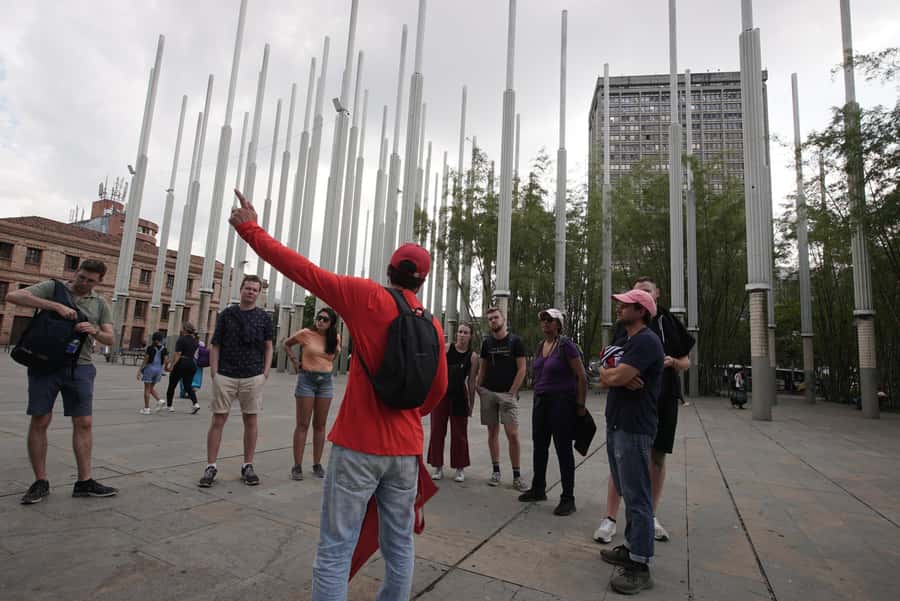
The Park of Lights is presented as a tribute to the father of Medellín’s railroads. The park brings together the themes of transportation, development, public space, and memory that have appeared throughout the walk.
This is not simply another place to take a picture. The guide explains how the railroad helped shape the city and why the park carries symbolic weight. You’ll see how Medellín uses central public areas to tell its own story, including the story of economic growth and the effort to create more welcoming shared spaces.
The Park of Lights also gives the tour a good visual ending. After streets, passages, art, and historic buildings, you reach a large public area that makes the city’s changes easier to discuss. It is a useful place to pause and think about the difference between a city’s reputation and its present-day reality.
Still, do not mistake a central walking tour for a complete picture of Medellín. The route focuses on downtown history, not every neighborhood or attraction. You will need other outings to understand the wider metropolitan area.
The 1980s and 1990s, discussed without a simple script
The hardest part of the tour is also one of its main reasons to book. Medellín’s violent past is discussed directly, including the effects of drug trafficking during the 1980s and 1990s.
The stated aim is to present the history without taboos and without taking sides. In practice, the experience is likely to feel sympathetic to Medellín’s progress and proud of the city’s recovery. One account of the tour found it informative but not entirely free of a point of view, so you should listen critically and remember that no three-hour walk can explain every political and social position.
The stronger guides avoid turning the subject into a crime-themed spectacle. Sebastian is praised for giving an account that was not focused only on narcos or drug trafficking. Daniel is noted for describing the transformation underway while also acknowledging current challenges. Santiago and Miguel are repeatedly praised for making difficult material clear and engaging.
That balance matters. You’ll hear about violence, but also about resilience, collective work, and social investment. The goal is to explain how Medellín moved toward a different future, not to claim that every problem has disappeared.
Downtown can feel rough around the edges. You may encounter aggressive begging and people dealing with serious addiction. This can be uncomfortable, especially if you expect a polished sightseeing district. The guide cannot solve those problems, but a frank tour should help you understand that Medellín’s progress exists alongside visible hardship.
Wireless audio, shared groups, and the walking pace
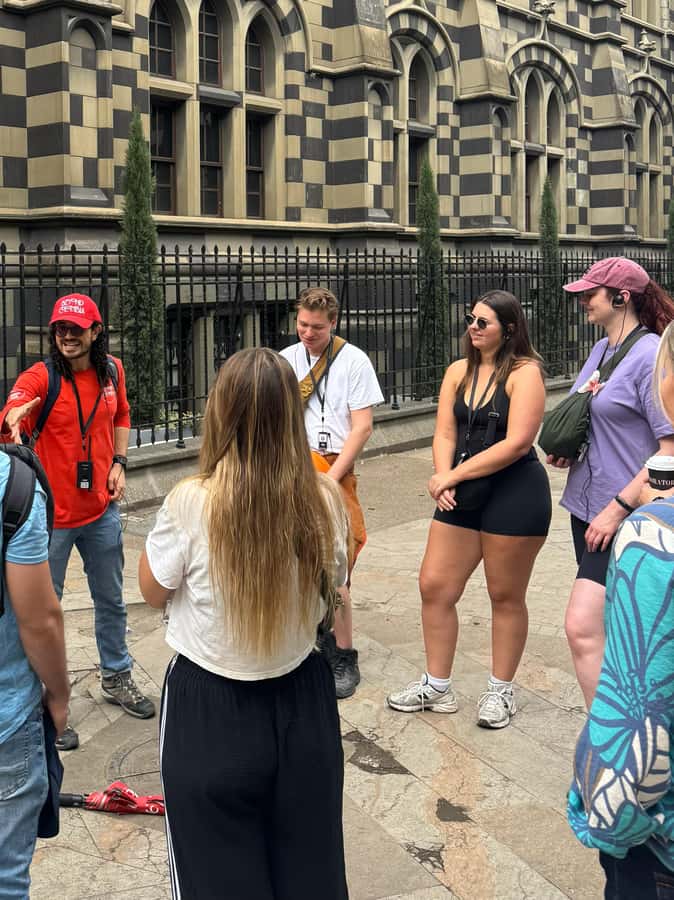
The audio system is one of the practical advantages here. Each participant receives a wireless audio receiver, allowing the guide to speak clearly even when traffic, street noise, or a large group makes ordinary conversation difficult.
You can also step to the side for a photograph and keep listening. That sounds minor, but it makes a long walk less frustrating. Without audio equipment, you often have to choose between staying shoulder to shoulder with the guide and seeing the street properly.
The equipment has limits. It is not suitable for children under 15, and it cannot get wet. If the weather turns rainy, the guide must collect the devices. Bring your own water and dress for changing conditions.
This is a shared tour, not a private walk. You will meet other people, and the guide’s attention must be divided. The upside is the low cost and the chance to exchange ideas with people from different countries. The downside is less control over pace and stop length.
The tour can run for 150 minutes or closer to three hours. That depends on the group, guide, and conditions. If you have a fixed afternoon appointment, leave generous extra time.
What the guides add to the experience
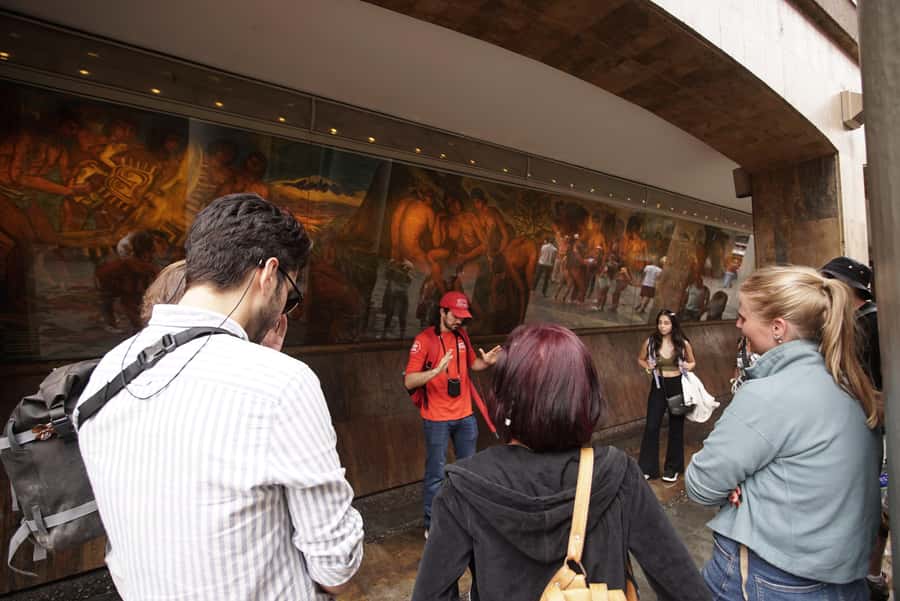
The company uses English- and Spanish-speaking local guides, and guide quality is clearly central to the experience. Names that receive particularly strong praise include Miguel, Santiago, Carolina, Deisy, Daniel, Sebastian, Alex, Manuel, Alejandro, and Jhon.
You should not book expecting one specific person unless your reservation confirms that. Still, the pattern is encouraging: guides are described as warm, energetic, and well prepared, with strong English in many cases.
Carolina is noted for checking that Spanish learners understood her explanations. Alex is praised for handling political and social questions without relying on a rigid script. Miguel is repeatedly described as passionate about his city and helpful with ideas for what to do next. Santiago is often praised for an easygoing delivery, historical detail, and practical advice.
That last point is important for a first day in Medellín. The guide can orient you to downtown, suggest places for coffee and souvenirs, and help you plan later activities. You are paying for interpretation, but you also get a useful local briefing.
Is $13 a good value for three hours?
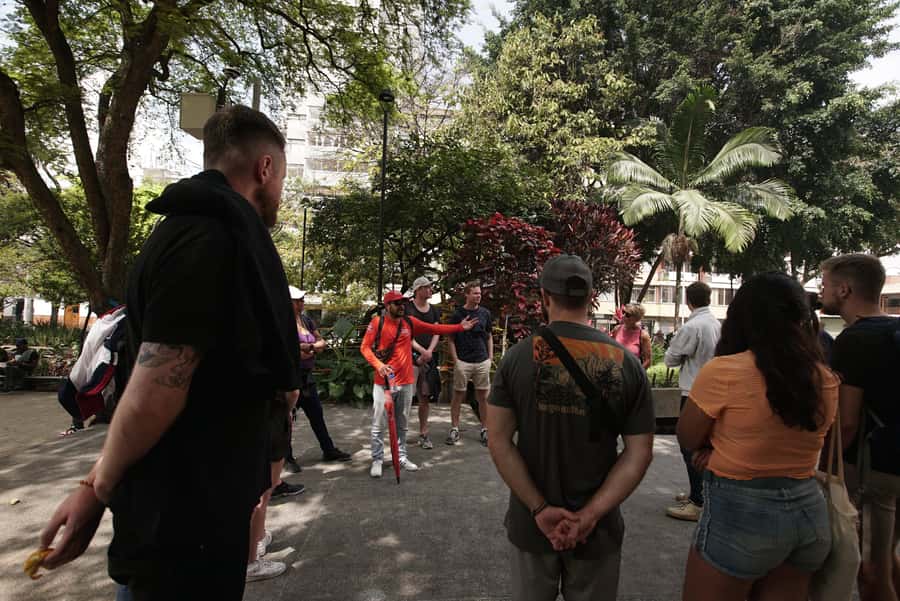
At $13 per person, this is a strong value if you want a serious introduction to Medellín. You are not paying for transport, meals, drinks, souvenirs, or admission tickets. The route is on foot, and no surprise entrance fees are part of the plan.
The value comes from the guide’s time and the structure of the walk. You could visit Botero Plaza, Junín Street, La Alpujarra, and the Park of Lights by yourself. What is harder to recreate is the connection between those places, especially the link between art, railroads, Paisa industry, violence, and social change.
The price also makes the tour useful for budget-conscious visitors. You can spend more later on museums, food, or day trips while still getting a substantial downtown orientation.
I would not choose it if you dislike long walks, crowded streets, serious historical discussion, or shared groups. It is also not suitable for people with mobility impairments, and the audio equipment creates an age limit for children under 15.
Free cancellation up to 24 hours before the start and the option to reserve now and pay later add flexibility. Those terms are helpful if your Medellín plans may change, but the main question is whether you want to spend several hours walking downtown.
Who should book this Medellín walking tour?
I recommend it most strongly for first-time visitors who want context before exploring on their own. It gives you a framework for the city, then points you toward coffee, lunch, souvenirs, and other activities.
It also suits anyone curious about Medellín beyond crime stories. You’ll hear about the 1980s and 1990s, but the route gives equal attention to art, industry, transportation, public space, and the city’s effort to build a better future.
Spanish speakers and English speakers can both take the tour. If your Spanish is limited, the English option and wireless audio should make the explanations easier to follow.
I would be more cautious if you have limited stamina or want a relaxed photo walk. Eight kilometers is substantial, and downtown conditions can be noisy, crowded, and confronting. Comfortable clothes matter more than looking polished.
Should you book the Shared Medellín Downtown Tour?
Book it if you want a low-cost, substantial introduction to Medellín and you are ready to walk. The best reason to go is the range of subjects: Botero’s art, Paisa culture, railroad development, public investment, and the city’s difficult recent past all fit into one route.
Go with an open mind and realistic expectations. This is not a private tour, not a museum visit, and not a spotless postcard version of downtown. It is a long, direct look at a complicated city, made more useful by local guides who can answer questions and point you toward what to do next.
At $13, the value is excellent for a first day. Just wear proper shoes, carry water and rain protection, protect your belongings, and leave room in your schedule for the walk to run close to three hours.
FAQ
Where does the tour meet?
Meet in front of the Museo de Antioquia at Botero Plaza. Look for the Beyond Colombia team with red umbrellas.
How long does the tour last?
The tour lasts approximately 150 minutes to three hours. Check the available starting time when booking.
How much walking is involved?
You’ll walk about 8 kilometers, with resting stops and time to listen to the guide.
Is transportation included?
No. You must make your own way to the meeting point, and the tour itself is conducted on foot.
Are food, drinks, or entrance tickets included?
No. Food, drinks, souvenirs, and entrance tickets are not included. The route does not take you to places with sudden extra charges.
What languages are available?
The tour is offered in English or Spanish with a live guide.
Can children use the wireless audio system?
The wireless audio system is not suitable for children under 15 years old.
What should I bring?
Bring comfortable shoes, water or another drink, weather-appropriate clothing, and a camera. An umbrella or rain cape is also recommended, since the audio equipment must be collected if it rains.
Just added around Medellin
- Comuna 13: Recorrido de Arte Urbano, Cultura y Resiliencia★ 5.0 · 3 reviews
- Tour to Río Claro and La Caverna del Cóndor★ 5.0 · 3 reviews
- Medellin: Tour to The Cathedral – History of Pablo Escobar and his Impact★ 5.0 · 3 reviews
- Medellín: Coffee Tour Experience at a Coffee Farm★ 4.8 · 3 reviews
- Medellin: waterfalls and naturals poolls tour★ 3.7 · 3 reviews
- Tour Medellín: Pablo Escobar and Commune 13★ 5.0 · 3 reviews
- Medellín: Private City Tour and Comuna 13 Tour★ 3.8 · 3 reviews
- Colombia: Official Pablo Escobar Meet the Family Museum Tour★ 5.0 · 3 reviews
Medellín Tours, compared.
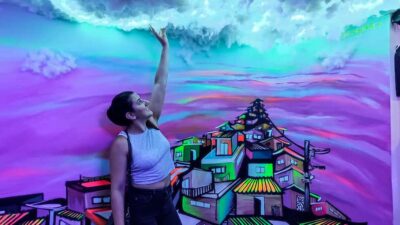
Medellin: Comuna 13 Graffiti Tour, Cable Car & Street Food
Read our review →
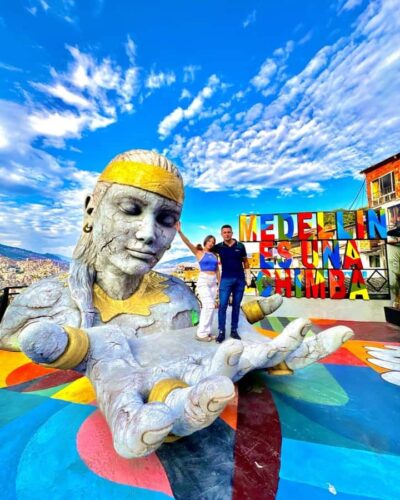
Medellín: Comuna 13 True Story and Street Food Tour
Read our review →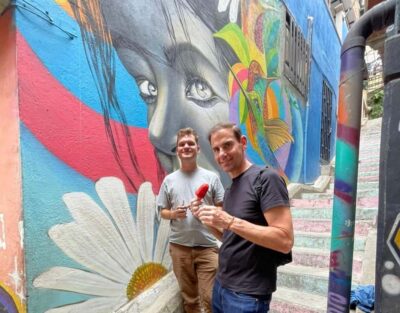
Medellín: Comuna 13 District Tour with Cable Car Ride
Read our review →
Medellin: Coffee Tour with Transport, Snacks and Tastings
Read our review →
From Medellín: Paragliding Tour with GoPro Photos & Videos
Read our review →
Medellín: Pablo Escobar Tour with beer included
Read our review →Browse the lists this tour appears in